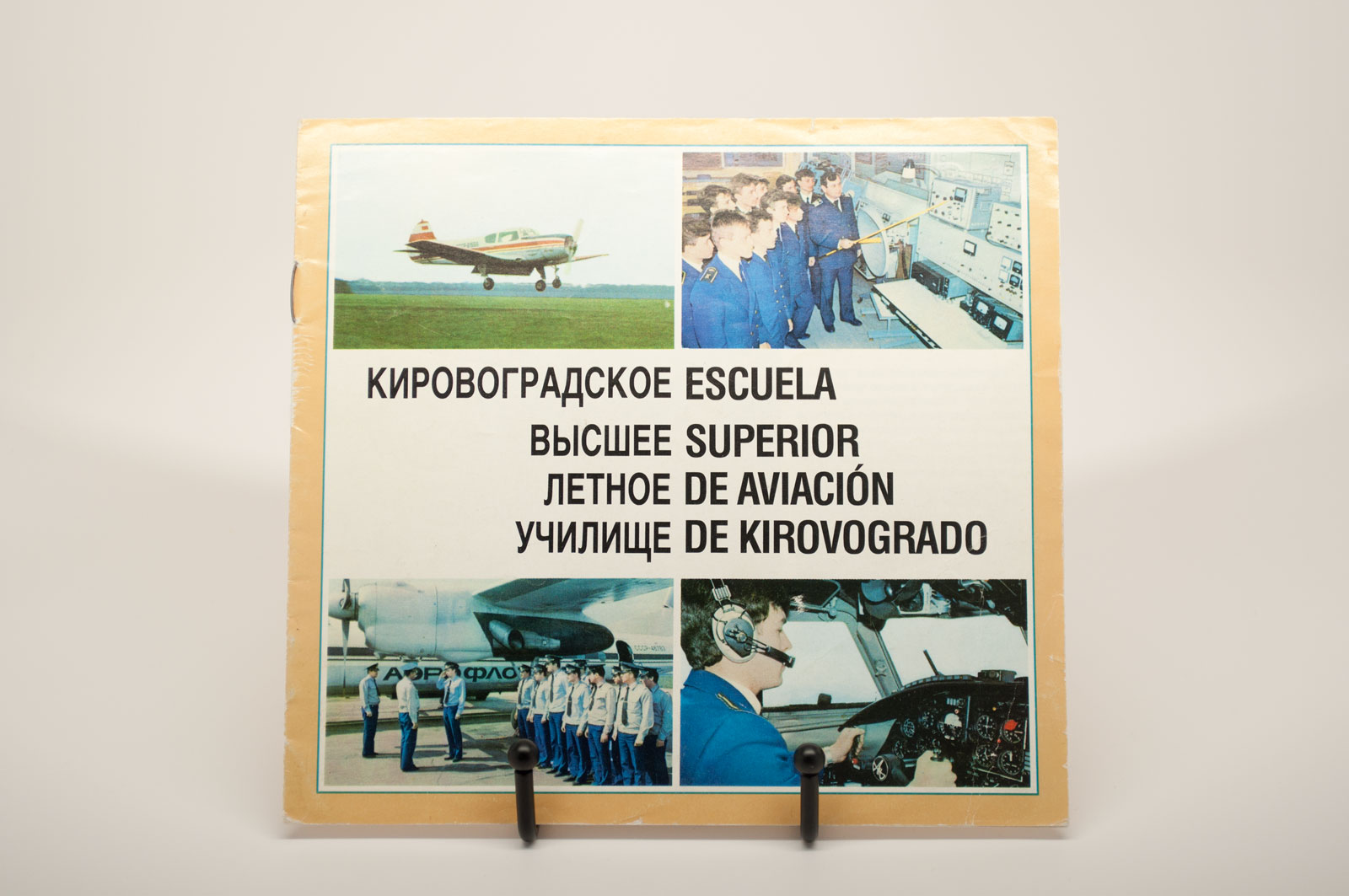
The Kirovograd Higher Flight School of Civil Aviation (КВЛУГА) held a legendary status during the Soviet era. Located in central Ukraine in Kirovograd, now Kropyvnytskyi, it grew into one of the premier aviation institutions across the entire USSR and the wider Eastern Bloc, serving as a primary pipeline for both Aeroflot and international civil aviation.
The facility was originally established in 1951 as the 60th Military Aviation Flight College for Long-Range Aviation.
During its military phase, the school was responsible for training Red Army aircrews on early jet bomber platforms, most notably the Ilyushin Il-28.
In 1960, under Nikita Khrushchev’s sweeping military downsizing policies, the military airbase and facilities were transferred entirely to the Soviet Ministry of Civil Aviation.
Renamed the Kirovograd School of Higher Flight Training of Civil Aviation (ШВЛП/ShVLP), the school's mission shifted to training the massive influx of personnel required by Aeroflot as Soviet civil aviation entered the jet and turboprop era.
Between 1960 and 1978, the institution trained over 37,000 aviation specialists, including tens of thousands of commercial pilots, navigators, radio operators, flight engineers, and mechanics.
Cadets and transitioning pilots trained on a huge variety of Soviet workhorses, ranging from the light An-2 utility biplane up to multi-engine turboprops and twin-engine transports like the Li-2, Il-14, An-24, An-26, An-30, and Yak-40.
As modern airliner systems grew increasingly complex, civil aviation required formal higher engineering/academic degrees rather than basic vocational flight instruction.
In 1978, the facility was officially elevated to the Kirovograd Higher Flight School of Civil Aviation (КВЛУГА).
Cadets completed a rigorous 4- to 5-year university-level program, graduating not only with commercial pilot licenses and multi-engine ratings but also with formal higher degrees in aeronautical engineering or air navigation.
In 1989, Kirovograd became the first aviation academy in the world to introduce multi-engine turboprop passenger aircraft (Let L-410 Turbolet) directly into the initial primary flight training curriculum for cadets.
One of Kirovograd’s most distinct roles during the Cold War was training foreign aviation personnel under state-sponsored Soviet technical aid programs.
Cadets, flight crews, and air traffic controllers were brought to Kirovograd from across the Warsaw Pact as well as Soviet-aligned nations across Africa, Asia, and Latin America.
By the time the USSR collapsed, the school had trained over 4,000 foreign specialists from more than 60 countries, making its diplomas recognized globally throughout non-Western civil aviation.